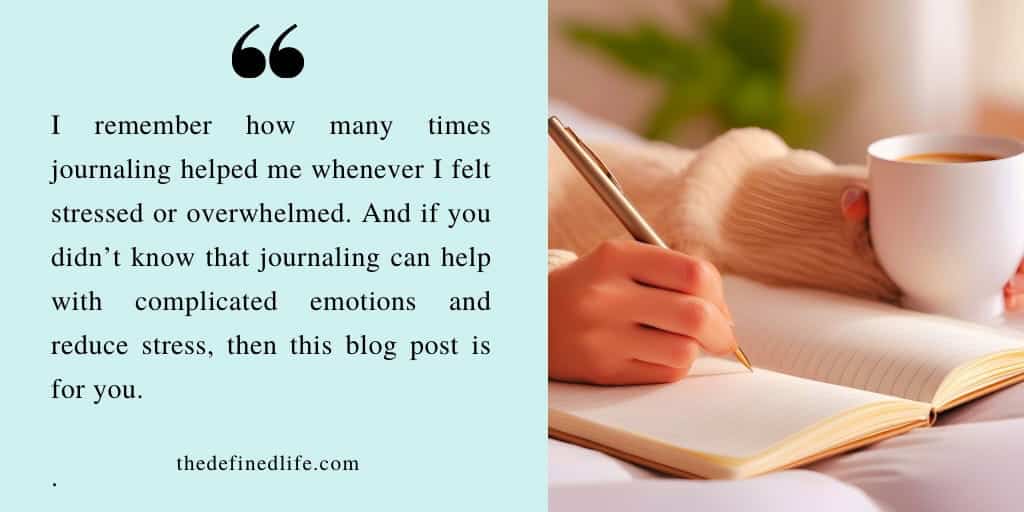
I remember how many times journaling helped me whenever I felt stressed or overwhelmed. And if you didn’t know that journaling can help with complicated emotions and reduce stress, then this blog post is for you.
If you are new to this, I suggest you begin with these journaling prompts for stress relief.
You don’t need to fix your life. You don’t need to “think positive.” All of this is about taking a small pause and creating a safe place to write.
If you like guided pages instead of blank ones, this is where a journal like Gentle Focus, my mindfulness journal, or Calm Mind, my CBT-style journal, can be really helpful. They gently guide your thoughts so you don’t have to figure out what to write from scratch when your mind already feels tired.
Table of Contents
Why Journaling Helps With Stress
Stress usually comes from holding too much inside. There are thoughts you don’t or can’t say out loud. Sometimes stress comes from worries you keep replaying.
Writing things down gives your mind a break. It slows your thoughts and helps you see them instead of just feeling them.
Journaling can help you:
- release built-up emotions
- sort out confusing thoughts
- feel calmer after a hard moment
- understand what’s really bothering you
This is exactly what I had in mind when I created my Gentle Focus Mindfulness Journal — something simple and quiet that helps you slow down instead of pressure yourself.
And for days when your stress comes from anxious thinking, the Calm Mind CBT Journal helps you gently untangle those thoughts instead of fighting them.
It’s not therapy, and it’s not magic. But it is a simple way to breathe and make space for yourself.

Want to browse other journaling related topics? Check out thedefinelife’s collection of journaling blog posts.
Journaling Prompts for Stress Relief
For starters, you can pick one or two that match how you feel today.
- “Everything I’m worrying about right now is…” – This helps because anxiety loves to keep worries tangled together. Writing them out one by one makes them feel smaller and more manageable.
- “The thought that keeps looping in my head is…” – This helps you notice the main thought causing stress instead of fighting every thought at once. Awareness is the first step to calming your mind.
- “If I could clear one worry today, it would be…” – This helps you focus on what matters most instead of feeling overwhelmed by everything.
- “What emotion is the loudest right now?”- Naming your emotions helps calm your nervous system. It turns a vague bad feeling into something specific and understandable.
- “What do I wish someone would understand about how I feel?” – This helps release feelings you may be holding in or not expressing out loud.
- “What comfort do I need today?” – This shifts your focus from “What’s wrong with me?” to “What do I need right now?”
- “Where do I feel stress in my body?” – This helps you notice how stress shows up physically instead of ignoring it. Start listening to your body instead of pushing through it.
- “What does my body need right now?”- This encourages care instead of forcing productivity when you’re already worn out.
- “What would help me relax even a little?”- This reminds you that small relief still counts. You don’t need total peace to feel better.
- “What am I carrying that isn’t mine to hold?” – This helps you see when you’re taking responsibility for things outside your control.
- “What can I release today, even temporarily?” – This allows you to loosen your grip instead of holding everything tightly.
- “What would happen if I stopped controlling this?” – This challenges the fear that everything will fall apart if you let go.
- “What feels safe in this moment?” – This helps ground you when anxiety pulls you into worst-case thinking.
- “What is okay right now, even if everything else isn’t?” – This helps balance anxious thinking by reminding you that not everything is wrong.
- “What small thing can I do to feel calmer?”- This keeps you focused on gentle actions instead of big solutions.
- “What’s one thing I handled better than I expected?” – This helps build confidence when stress makes you feel incapable.
- “What is not as bad as my mind says it is?” – This helps you learn to question anxious thoughts instead of believing them automatically.
- “What would I tell a friend who felt this way?” – This helps you treat yourself with the same kindness you give others.
A Sweet Reminder
Sometimes, or maybe most of the time, we cannot completely remove stress. There are things that are simply out of our control.
What we can do is sort through our situations, name our emotions, and acknowledge how we feel.
Being stressed is not a nice feeling. It can feel like living in survival mode. If feelings become overwhelming, journaling is a free and simple way to help manage them. Start by using these journaling prompts for stress relief.
Final Thoughts on Journaling Prompts for Stress Relief
Stress won’t magically disappear because you wrote in a notebook. But journaling gives your stress somewhere to go instead of staying trapped inside you.
Just pick one question and write a few lines.
See how you feel and remember that this alone is already a form of relief.
So here’s a simple one to start with:
What’s been weighing on my mind the most today?
And if you want to share…
Which prompt feels easiest for you right now







Leave a Reply