Junk Journal Binding Methods: 5 Ways to Bind Your Pages
So you’ve got your pages ready, your ephemera collected, and now you’re just staring at a pile of paper thinking… okay, what now?
That’s exactly where I was when I first started junk journaling. Binding felt like the most confusing step because there are so many ways to do it and nobody really explains which one to start with.
Here’s the thing though , it doesn’t have to be complicated. Some of the most beautiful junk journals out there are held together with the simplest methods. You don’t need fancy tools or bookbinding experience to make something that looks and feels amazing.
In this post I’m walking you through 5 junk journal binding methods — how each one works, what you’ll need, the pros and cons, and which ones are actually beginner-friendly. By the time you’re done reading this you’ll know exactly which method to try first.
Let’s get into it.
Table of Contents
Before You Pick a Binding Method, Ask Yourself These Questions
Not every binding works for every journal, so it helps to think through a few things before you dive in:
How many pages do you have? Some methods work best for thin journals, others can handle a big chunky stack of mixed materials.
Do you want to be able to add pages later? If yes, you need a binding that allows for that. (Ring binding is your friend here.)
What tools do you have? Some methods need a needle and thread or an awl. Others need nothing except a stapler or some glue.
Is this your very first journal? If so, keep it simple. You can always try more involved methods once you’ve got one journal under your belt.
Okay, now let’s talk methods.
1. Pamphlet Stitch Binding
This is one of the oldest bookbinding methods out there, and it’s a lot easier than it sounds. Basically, you fold your pages into a little booklet, punch a few holes along the fold, and stitch them together with needle and thread.
How to do it: Fold your pages in half so they form a booklet shape. Use an awl or a thick needle to punch 3 holes along the fold — one in the middle and one near each end. Thread your needle and stitch through the holes in a simple in-and-out pattern. Tie it off, trim the thread, and you’re done.
That really is it.
Pros:
Very beginner-friendly once you’ve done it one time
Gives your journal a clean, classic look
No special tools beyond a needle, thread, and something to poke holes with
Cons:
Works best for thinner journals — too many pages and the spine gets bulky
You can’t easily add pages after it’s bound
Beginner tip: Use waxed linen thread or embroidery floss — both are strong and the colors can become a pretty design detail on the spine. Watch one YouTube video on the pamphlet stitch before you start. Seriously, just one video and you’ll feel totally confident.
2. Coptic Stitch Binding
Okay, Coptic stitch is a little more involved, but I’m including it here because it’s one of the most popular methods in the junk journaling world and you’ll hear about it constantly. The big reason people love it? The journal opens completely flat, which is amazing for art journaling and mixed media pages.
How it works: Your pages are divided into multiple signatures (small groups of folded pages). Those signatures are then stitched together through the spine using a linked stitch pattern, leaving the spine exposed and visible. That exposed spine becomes a really beautiful design feature.
Pros:
Opens completely flat
The exposed spine looks stunning
Very sturdy and long-lasting
Can handle heavier, thicker pages
Cons:
More complex — it takes practice to get it right
You need consistent page sizes for the signatures to work
Not the best starting point if you’ve never done any bookbinding
Beginner tip: Don’t make this your very first binding attempt. Start with pamphlet stitch to get comfortable with the basic idea of sewing pages together, then come back to Coptic. There are tons of free tutorials on YouTube and it’s way less scary once you have a little foundation.
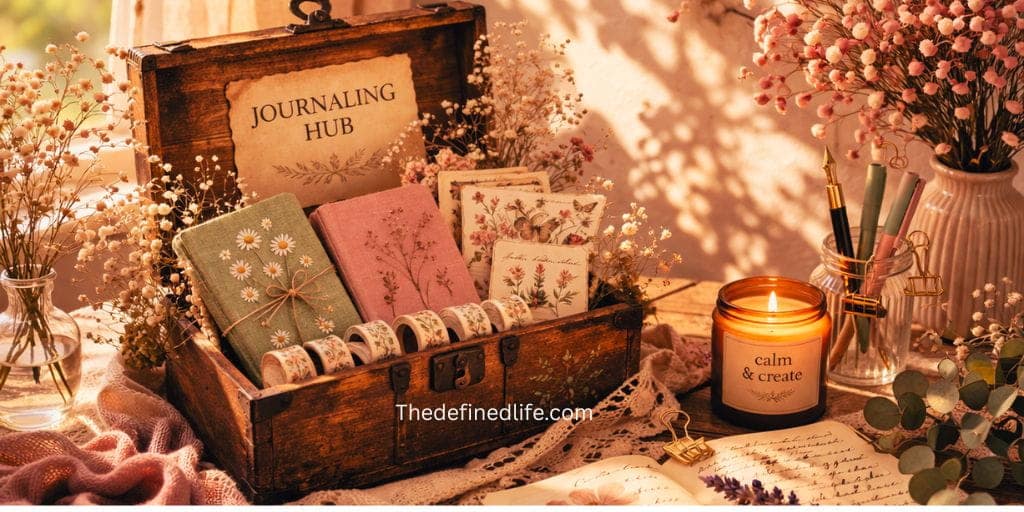
Want all my best journaling resources in one spot? Head to my Journaling Hub and bookmark it.👇🏻
3. Ring Binding
Ring binding is probably the easiest method on this entire list. You punch holes along the edge of your pages and clip them together with metal rings. Done.
How to do it: Use a hole punch to punch holes along one edge of your pages. Clip them together with binder rings — the kind you can get at a dollar store or any office supply store. If you want cleaner, more uniform holes you can invest in a binding punch system, but it’s totally not necessary when you’re starting out.
Pros:
No sewing, no glue — just punch and clip
You can add, remove, and rearrange pages whenever you want
Works with pretty much any thickness or type of material
Fast — you can have a working journal in minutes
Cons:
Rings can catch on thin paper and cause tearing if you’re not careful
Doesn’t have the same handmade feel as a sewn binding
Can look a little plain if you don’t put some effort into the cover
Beginner tip: This is honestly where I’d tell any brand new junk journaler to start. Grab some binder rings from the dollar store, punch your holes, and you have a journal. Decorate the cover and no one’s going to know it’s held together with office supplies.
4. Japanese Stab Binding
Japanese stab binding (sometimes called stab stitch binding) is a traditional method where you sew through a stack of flat pages along the spine. The difference from pamphlet stitch is that your pages aren’t folded — they’re stacked flat and stitched together along one edge.
How to do it: Stack all your pages flat. Punch a row of holes along one edge using an awl. Use a needle and thread to sew through all the pages in a repeated pattern. The stitching shows on both the front and back cover, which turns into a decorative feature. There are a handful of classic stitch patterns to choose from, and even the simplest one looks really impressive.
Pros:
Works for thin journals and chunky mixed media books
The stitching pattern is beautiful and customizable
Handles different page sizes and materials well
Easier than Coptic stitch but looks just as cool
Cons:
The journal doesn’t open completely flat
You can’t add pages after it’s bound
You need an awl to get clean holes through a thick stack
Beginner tip: Japanese stab binding is a great middle-ground method. More interesting than ring binding, but not as complicated as Coptic. Start with the basic 4-hole pattern — it’s simple and looks really polished.
5. Glue or Tape Binding (No-Sew)
If you just want to make your first junk journal as fast as possible, this is your method. No needles, no holes, no thread. Just glue.
How to do it: Stack all your pages together and clamp them along the spine. Apply PVA glue (bookbinding glue) along the spine edge and let it dry completely. Once it’s dry, cover the spine with a strip of fabric, decorative tape, or washi tape to finish it off. Some people also use wide book binding tape folded over the spine and it works great.
Pros:
Easiest method of all — no special skills needed
Great for odd-sized pages and mixed materials
Fast — you can finish a journal in under an hour
You don’t need much beyond glue
Cons:
Not as durable as sewn bindings over time with heavy use
Doesn’t open completely flat
The spine can look a little rough if you don’t finish it off
Beginner tip: Use PVA glue instead of hot glue — it dries stronger and more flexible. Then cover the spine with a pretty strip of fabric or washi tape. It looks cute and intentional, I promise.
So Which Method Should You Actually Start With?
Here’s how I’d break it down:
Never bound a journal before? → Start with ring binding or glue binding. Both are fast, low-stress, and get you to the fun part quickly.
Comfortable with basic crafts and want to try sewing? → Go with pamphlet stitch. It’s beginner-friendly, looks beautiful, and gives you a great foundation for trying more complex methods later.
Want to be able to add pages over time? → Ring binding is the only method here that makes that easy.
Ready for more of a challenge? → Try Japanese stab binding first, then work up to Coptic stitch. Both take more effort but the results are genuinely worth it.
Tools You’ll Need
Depending on which method you go with, here’s what to have on hand:
Awl or bookbinding needle — for punching clean holes (needed for pamphlet, Coptic, and stab binding)
Waxed linen thread or embroidery floss — for any sewn binding
Binder rings — for ring binding (dollar store works fine)
PVA glue — for glue binding (stronger and more flexible than regular white glue)
Bone folder — helps you get clean, crisp folds (optional but really nice to have)
Binder clips — for holding pages together while glue dries
Washi tape or fabric strip — for finishing off the spine on a glue-bound journal
Most of these are cheap and you probably already have some of them. Don’t buy everything at once — start with what you have and add tools as you try new methods.
Okay, Now Go Make Something
Pick a method and just try it. That’s really the only way to learn. Don’t wait for perfect supplies or the perfect stack of pages.
If you’re still putting your pages together and figuring out what junk journaling is even about, start with my beginner’s guide to junk journaling — it covers everything you need to know before you get to the binding stage.
And if you want a set of beautiful ready-to-print pages to work with so you can skip the hunting-for-materials stage and just focus on the craft, I have printable junk journal kits in my shop. My Botanical Junk Journal Kit comes with coordinated papers, ephemera, and tags that are designed to work together — so you can pick your binding method and just go.
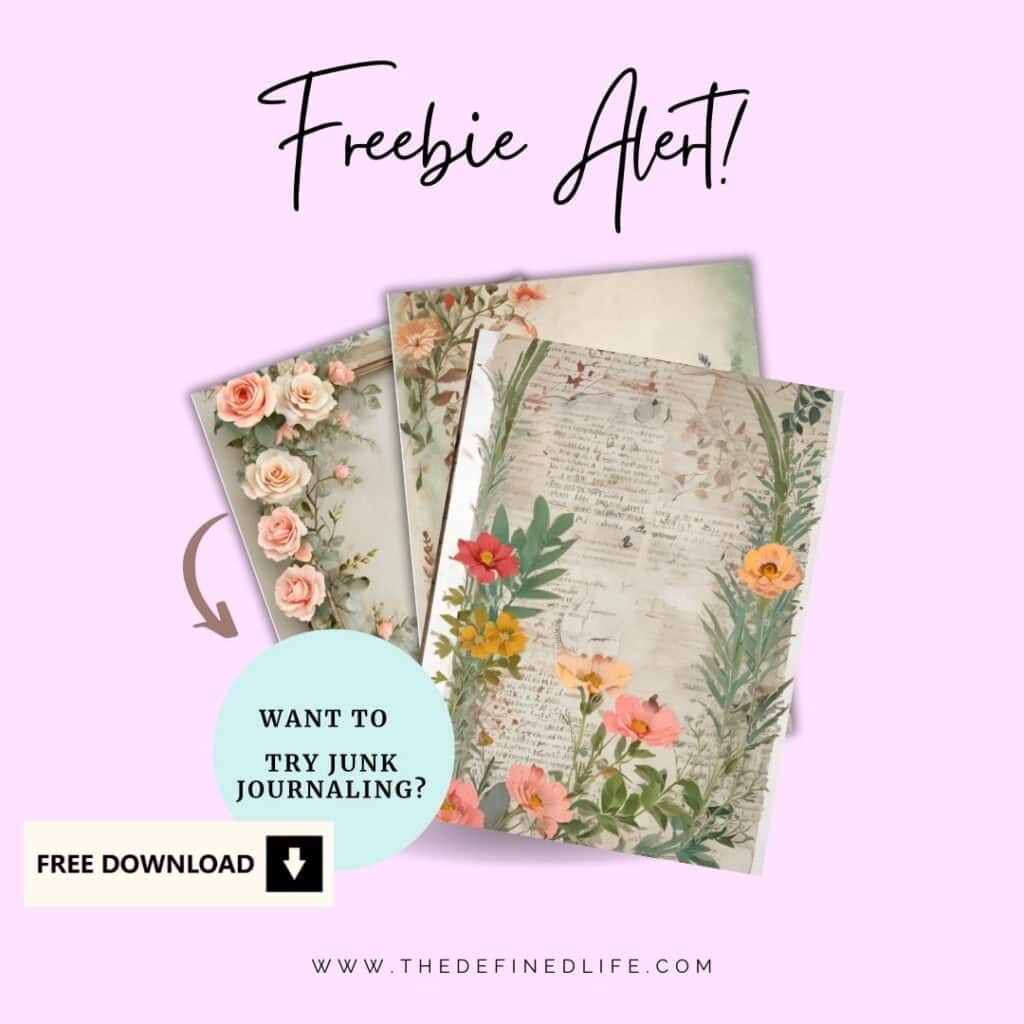
Want to try printable pages before you commit? Grab the free 3-page sampler and see if they’re your thing.
This website uses cookies to improve your experience. We'll assume you're ok with this, but you can opt-out if you wish. Cookie settingsACCEPT
Privacy & Cookies Policy
Privacy Overview
This website uses cookies to improve your experience while you navigate through the website. Out of these cookies, the cookies that are categorized as necessary are stored on your browser as they are essential for the working of basic functionalities of the website. We also use third-party cookies that help us analyze and understand how you use this website. These cookies will be stored in your browser only with your consent. You also have the option to opt-out of these cookies. But opting out of some of these cookies may have an effect on your browsing experience. Please click this link to read more about our Privacy Policy and Disclaimer.
Necessary cookies are absolutely essential for the website to function properly. This category only includes cookies that ensures basic functionalities and security features of the website. These cookies do not store any personal information.
Any cookies that may not be particularly necessary for the website to function and is used specifically to collect user personal data via analytics, ads, other embedded contents are termed as non-necessary cookies. It is mandatory to procure user consent prior to running these cookies on your website.







Leave a Reply